Ontario Changed Job Posting Rules in 2026. Newcomers Should Pay Attention to One Rule Most.
Salary ranges now appear in job postings. Employers cannot ask for Canadian experience in postings. Employers also need to respond within 45 days after an interview. One change matters most for newcomers.
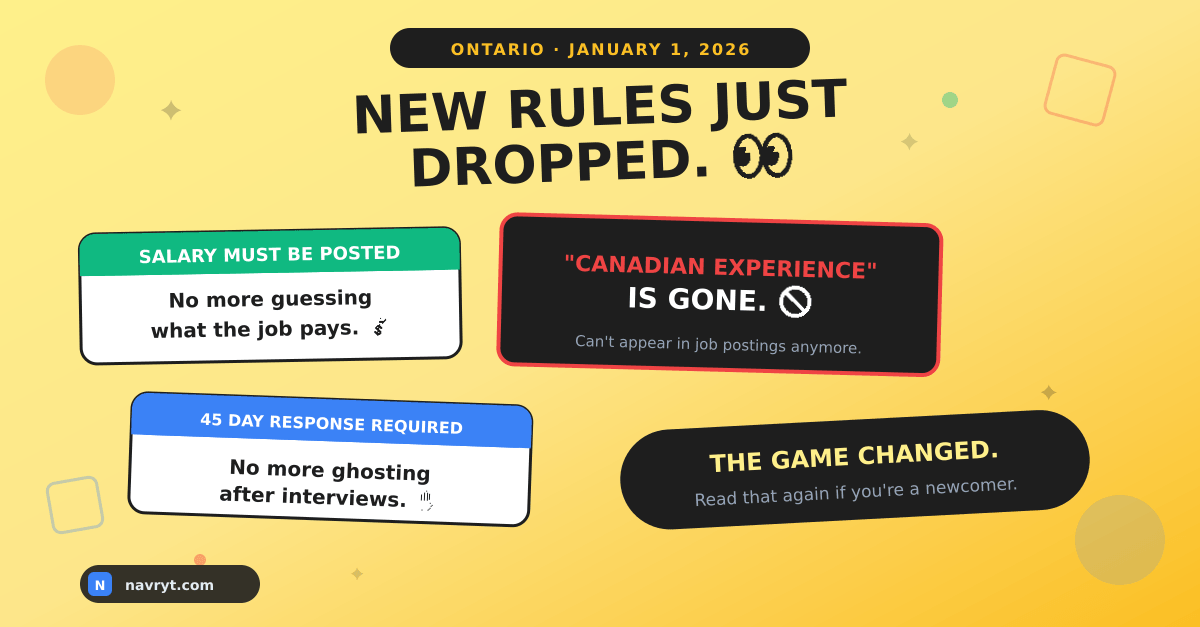
Ontario changed job posting rules in 2026. Many people will notice the salary range first. Newcomers should pay close attention to something bigger. Employers cannot say Canadian experience is required in a job posting.
That matters because many internationally trained professionals get screened out before a real conversation starts. This change removes one obvious barrier. It does not remove every barrier.
What Changed in Plain English#
1. Salary ranges now need to show up front#
This helps you filter faster. If one operations role pays $48,000 to $55,000 and another pays $62,000 to $75,000, you can make a better decision before spending hours on an application. That is better for job seekers and harder for employers to stay vague until late in the process.
2. Employers cannot ask for "Canadian experience required" in postings#
Newcomers should care about this change most. For years, that phrase worked like a shortcut filter. It let employers dismiss strong people from Lagos, Mumbai, Manila, Dubai, London, or Sao Paulo before they looked at what those people had done.
In plain English, your experience does not lose value because you gained it outside Canada. If you solved the problem, led the work, improved the process, or delivered the result, that experience still counts. Job postings should not suggest otherwise.
3. Interview follow-up now has a clock#
The 45 day response rule matters because silence after interviews wastes time and keeps candidates stuck. A clear timeline helps you decide when to follow up, when to move on, and how to manage the rest of your search.
What This Means for Newcomers#
- You should be able to compare compensation earlier instead of guessing.
- You should not see job ads openly screening people out with "Canadian experience required."
- You get a clearer expectation around post-interview communication.
- You still need to present your experience in a way local employers understand quickly.
This Helps. You Still Need a Strong Search.#
These rules help. They make postings clearer. They remove one blunt filter. They give candidates a better sense of what happens after an interview.
But rules do not write your resume for you. Rules do not explain your experience well. Rules do not stop every employer from favoring familiar backgrounds. You still need clear positioning, strong examples, and a focused search.
What You Should Do Now#
- Use salary ranges to screen faster and focus on roles that actually fit your level.
- If you see outdated language like "Canadian experience required," document it and move on to better employers.
- Translate your international experience into results, numbers, tools, and business outcomes that recruiters can compare quickly.
- Treat interviews like a conversion stage: prepare strong stories, follow up professionally, and keep multiple applications moving at once.
Where Navryt Fits#
If these rule changes make you realize your next bottleneck is not the posting but your positioning, resume, and interview prep, start with Navryt™. Navryt™ helps newcomers present international experience in a way employers understand fast. That makes new rules more useful in a real job search.