"Walk Me Through Your Resume?" The Story Behind Your Experience
Your interviewer already has your resume in front of them. So why ask you to walk through it? The answer is in how you connect your experience to the work you want next.
In this article
Ana has her answer to "Why this role?" ready now. Her next interview opens with another question.
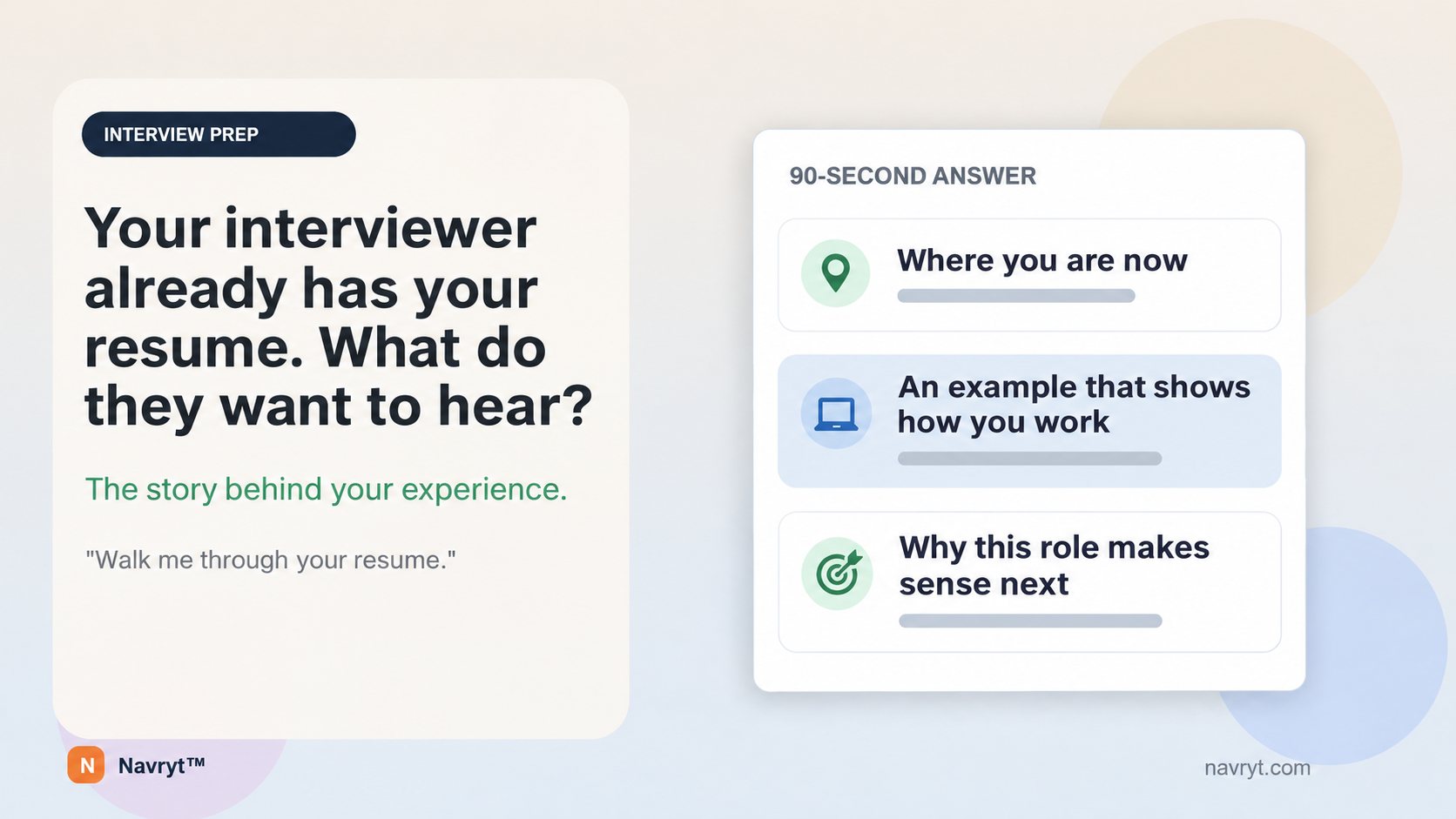
"Walk me through your resume."
She starts at the top of the page and lists her titles, companies, and duties. The details are accurate, but the answer leaves out how the pieces connect.
The question gives her a chance to connect the experience on the page to the work she wants next. It is less about repeating every line and more about choosing the details that make her path clear.
She can add what the page cannot show: what she focused on, how she approached a challenge, and what she learned from the work.
The shape of a 90-second answer#
At Navryt™, we recommend a simple five-line structure. Ana uses it like this.
- Where you are now. One line on your current focus or the role you're targeting. "I'm a product specialist focused on using customer research to decide what gets built."
- Your strongest story. One accomplishment, told in three or four sentences. "In my last role, I interviewed small-business clients in three markets and found that new users were getting stuck during setup. I worked with the team to simplify onboarding. That experience showed me how customer research can shape product decisions."
- A bridge. One line that moves you back in time. "Before that, I worked in client support at a software company."
- A second, different story. Another accomplishment, with a different emphasis from the first. "That's where I learned to turn messy complaints into clear requests for the product team. The hardest part was getting engineers to trust feedback that came from support."
- A close that hands back control. Sum up anything else relevant in a line, then offer to go deeper. "I've also led small cross-team projects, and I'm happy to go into any of these in more detail."
That is the shape: choose two relevant examples from your experience and make clear what each one shows. Keep the answer focused, then leave room for the conversation to continue.
Why the stories carry the answer#
Notice how Ana's examples focus on different parts of her experience. One shows how she used customer research. The other shows how she worked across teams. Together, they give more context than a list of duties.
This is also where many newcomers have an advantage they don't use. Your experience may come from another country, a company the interviewer has never heard of, or a job title that doesn't exist here. A short, specific story translates that experience better than any title can.
The closing line is the most important one#
Look again at Ana's last line: "I'm happy to go into any of these in more detail."
The closing line is the most important one because it lets you finish clearly and gives the interviewer an easy way to choose where the conversation goes next. You have made your main points, and you are ready to expand on the one that matters most to them.
Have a short version too#
Some interview openings call for a shorter answer. Prepare a 40-second version too: one line on where you are now, your strongest story in brief, one line on other relevant experience, and the same offer to go deeper.
Prepare this before you apply#
Prepare this answer before an interview invite arrives, while you have time to choose the examples that best fit the role.
The real goal is flexibility. Once you have four or five strong stories written down, you can swap one for another depending on what each job needs. The structure stays the same. Only the stories change.
If you want to build your 90-second and 40-second answers step by step, start with Navryt™ for free. The Walk Me Through builder uses the stories you've already written to put your answer together, and the full module shows how to vary each one for the job in front of you.
Related reading#
You Have 60 Seconds. The Interviewer Just Said "Tell Me About Yourself."
"Why Do You Want This Role?" The Question That Makes Your Fit Clear